
Forecasting photovoltaic generation across space.
SentinelPV develops a scalable methodology for short-term photovoltaic forecasting by combining representative monitored plants, geospatial analysis, physical modelling and artificial intelligence.
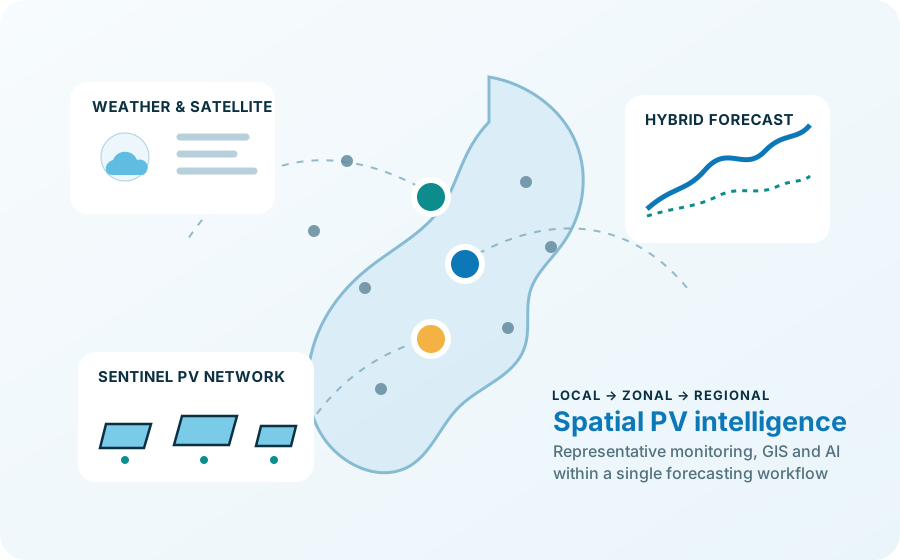
Forecasting a distributed and variable energy source.
Photovoltaic generation is increasingly distributed across the territory, while real-time production data are available only for a fraction of systems. SentinelPV investigates how limited but high-quality observations can improve short-term forecasts without requiring complete monitoring of the entire PV fleet.
Sentinel PV plants
A limited set of representative monitored systems is selected to describe the behaviour of wider geographical areas. Their role is to provide high-quality local observations that can be transferred, through spatial modelling, to larger groups of PV systems.
Discover the concept →Hybrid forecasting
Physical photovoltaic models are combined with machine-learning methods. The physical layer provides interpretable information on irradiance, temperature and system behaviour, while the data-driven layer captures complex temporal and spatial variability.
See the methodology →Geospatial intelligence
Production profiles are analysed together with meteorological, geographical and topographical information. This allows the project to study how PV behaviour changes across the territory and to define meaningful zones for regional forecasting.
Explore the spatial approach →From local observations to regional intelligence.
SentinelPV investigates the minimum amount of monitoring needed to obtain reliable information about a much larger distributed PV population. Rather than assuming that every installation must transmit real-time data, the project searches for representative observation points and the spatial scales at which their information can be generalised.
Forecasting is therefore treated as both a temporal and a spatial problem. The project combines PV physics, weather information, historical production and geospatial relationships to improve the reconstruction and prediction of photovoltaic generation over wider areas.
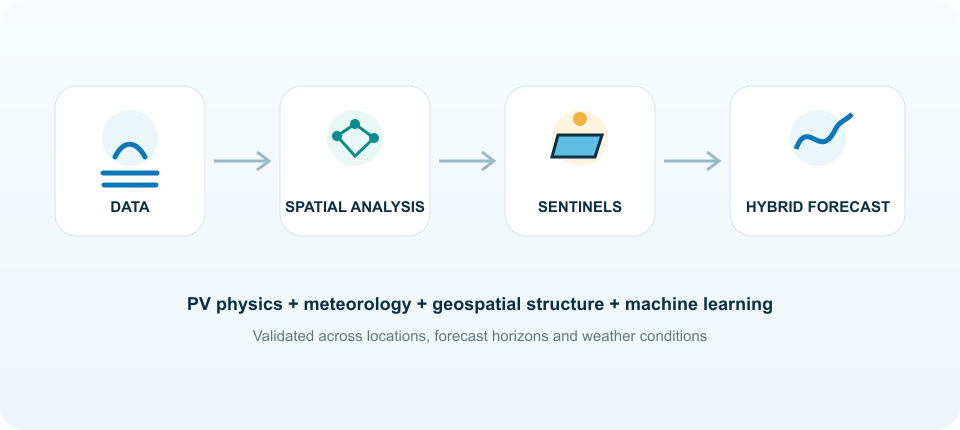
A five-stage workflow from data to validated forecasts.
The methodology connects heterogeneous data, spatial analysis, representative-site selection, hybrid forecasting and validation in a common research workflow.
Data integration
PV production, meteorology, numerical weather forecasts, plant metadata and geospatial layers are harmonised and quality-controlled.
Spatial clustering
Sites are grouped using geographical, topographical, meteorological and production-related information rather than distance alone.
Sentinel selection
Representative monitored systems are identified for each meaningful spatial zone and used as observation points for wider areas.
Hybrid models
Physical PV modelling is integrated with machine learning to capture deterministic behaviour and residual spatio-temporal variability.
Benchmarking
Forecasts are compared against common references and analysed across different weather regimes, horizons and spatial scales.
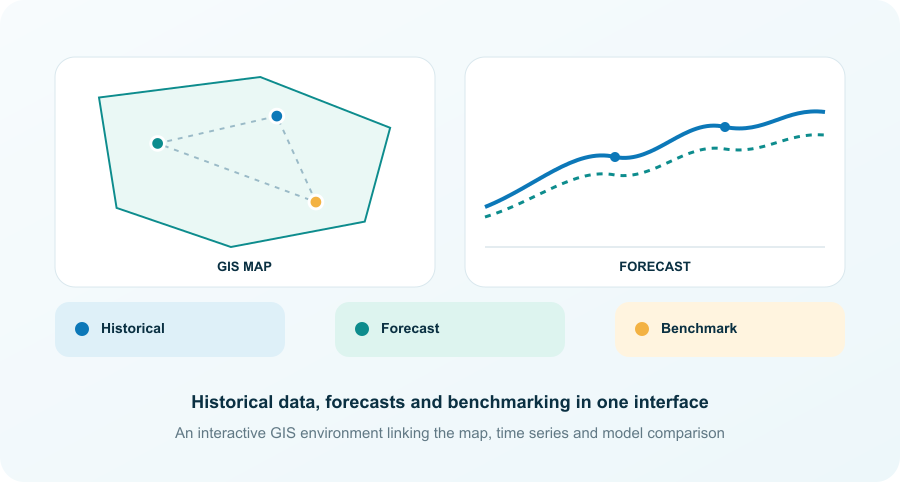
Explore forecasts, spatial information and model performance.
The web platform translates the research workflow into an interactive GIS-based environment. Users can move from the map to historical data, inspect forecasts for individual locations or wider zones, and compare different forecasting models and data sources.
The benchmark area combines geographical selection, time-series comparison, numerical performance indicators and error distributions. This makes it possible to evaluate not only average accuracy, but also how model behaviour changes with location, weather conditions and operating range.
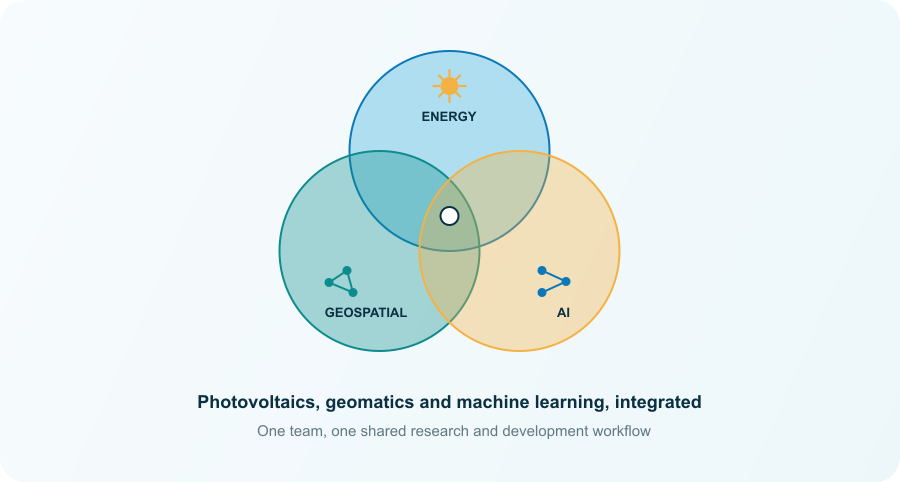
Energy engineering, geospatial science and artificial intelligence.
The project is interdisciplinary by design. Research on photovoltaic systems and power engineering is integrated with geomatics, spatial data science, machine learning and the development of an interactive web platform.
Collaborative research at Politecnico di Torino.
SentinelPV is developed within the 2025 University Research and Innovation Grants, Collaborative Research Projects line, with the support of Fondazione CRT and Politecnico di Torino.